Techture is a BIM and VDC service provider for dry-utility contractors in complex underground environments. From electrical conduits, telecom, and fiber optics to gas pipelines, we offer BIM and VDC solutions for the coordination, modeling, and documentation of underground dry utilities in a confined utility corridor.
With BIM, we facilitate accurate dry utility installations by providing coordinated models, clash-free routes, and construction drawings. By integrating design information with construction execution, we help contractors minimize rework, ensure more accurate installations, and maintain project schedules.

.svg)
.svg)

Dry utilities contractors work in a very constrained underground space where multiple services, such as electrical conduit, telecom, fiber optics, and gas pipes, have to be installed in the same trench. Lack of visibility into the underground space, as well as poor data available on the underground utilities, makes it difficult to plan the route accurately before the actual digging starts. Additionally, the challenges faced by dry utility contractors are further complicated by the fact that conflicts occur frequently with wet utility services, the time available for the job is very limited, and the underground space provides very little room for error.
Techture helps in overcoming the challenges faced by dry utilities contractors in the following ways:
.png)
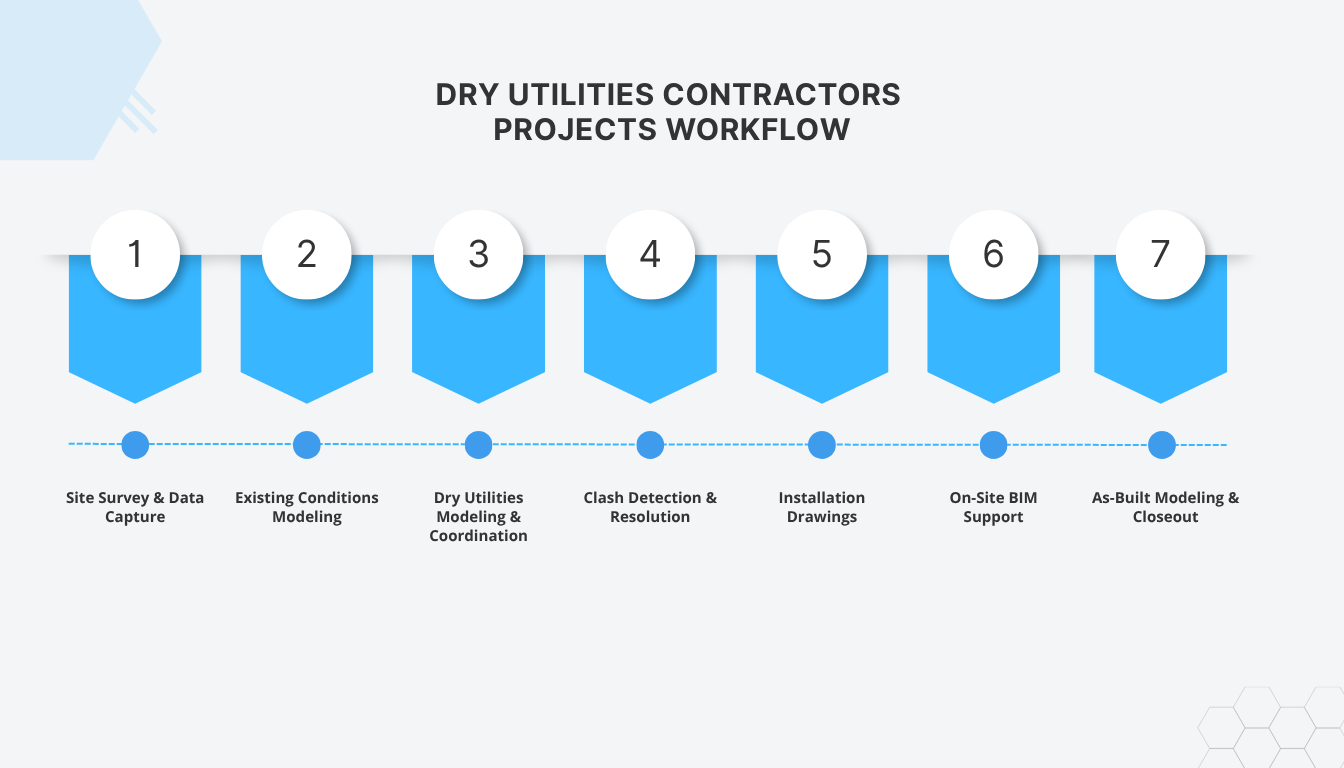
Dry utilities such as electrical, telecom, and data networks require proper coordination among underground and above-ground infrastructure. Lack of visibility in the existing infrastructure and conflicting layouts are major issues that affect the workflow. We, at Techture, help optimize the workflow for dry utilities through coordinated BIM models, utility mapping, and clash-free routing approaches.
Step 1: Site Survey & Existing Conditions Capture
Step 2: Existing Conditions Modeling
Step 3: Dry Utilities Network Modeling & Coordination
Step 4: Clash Detection & Resolution
Step 5: Construction-Ready Installation Drawings
Step 6: On-Site BIM Support & Updates
Step 7: As-Built Modeling & Project Closeout
End-to-End Support from Pre-Bid to Closeout
Faster Drawing Turnaround for Tight Schedules
Single Point of Coordination Across All Trades
Field-Aware BIM Delivery
Explore our project portfolio to see how we have helped our clients to achieve successful outcomes through Techture's BIM solutions and consulting services — from design to delivery.

Dry utilities include electrical conduits, telecom networks, fiber optics, gas pipelines, and street lighting. These differ from the wet utilities, which include water supply, drainage, and sewer networks. The difference between them is that they involve fluid flow. These two types of utilities may have shared corridors.
BIM facilitates the development of coordinated 3D models in which both dry and wet utility systems can be integrated and analyzed. Clash detection tools can be used to detect any possible conflicts, which can be resolved in the design stage before construction, thus reducing construction waste.
Yes. Techture works with design drawings, shop drawings, and survey information supplied by the contractor or consultant. This information not only helps create coordinated BIM models but also helps in construction documentation that meets specific project needs across different industries.
Project timelines vary depending on the project’s scope, complexity, and data availability. However, initial models and coordination results are generally available in a matter of weeks, with some results available in shorter periods depending on the deliverable, such as clash reports or installation drawings.
Yes. Techture offers ongoing BIM support during dry utility installation. This means that our BIM support will always be in sync with the actual construction site. Our team will be able to assist contractors in updating models and drawings as the project progresses.
3D laser scanning can be used to accurately survey site conditions and layouts of existing utilities. This information is then converted into point clouds, which allow precise modeling and coordination, reducing uncertainty and the chance of any clashes during construction.
Techture supports a wide variety of projects, including commercial projects, large-scale infrastructure projects, residential communities, industrial facilities, utility corridor developments, and various projects associated with dry utility infrastructure. Our BIM solutions can be used for various projects, irrespective of their size or complexity.







.jpg)
.jpg)
%20(2).jpg)


%20(1).jpg)
.jpg)
.jpg)
.jpg)
