.png)


Introduction
The construction industry is becoming increasingly interested in how the durability, maintenance, and environmental implications associated with construction can be favourably impacted. One of the most recent developments is a "smart" material known as bacterial concrete, capable of healing its own cracks. Sometimes also called self-healing concrete, this approach involves incorporating biological processes into traditional concrete to enhance its performance and service life.
Cracks in concrete are unavoidable, given shrinkage, thermal stresses, and external loading. Unless treated, these cracks provide an easy route of ingress for water and aggressive chemicals, resulting in the corrosion of reinforcement and structural failure long before the design service life. Cracks in the concrete will be self-healed by bacterial concrete autonomously, with a significant reduction in maintenance and extending the service life of structures. In addition, due to emerging interest in sustainable construction, bacterial concrete is lately receiving much attention as a durable, environmentally friendly building material.
In this article, we will deep-dive into all the essential topics related to bacterial concrete, such as its mechanism, benefits, application, limitations, and future, and help you understand the importance of the topic.
What is Bacterial Concrete?
Bacterial concrete is a type of modified concrete. It involves the use of special bacteria that produce limestone or calcium carbonate as a byproduct of their metabolism. The calcium carbonate will fill up the resultant cracks in the concrete and “heal” the concrete without outside help.
The commonly used bacteria belong to the Bacillus genus, including Bacillus subtilis and Bacillus sphaericus. Bacteria are chosen based on their resistance to strongly alkaline conditions (pH 12 to 13), which they can easily withstand, even being in the dormant state. When the concrete sets with cracks, the bacteria come to life.
For bacterial growth to occur, nutrients such as Calcium Lactate are incorporated into the concrete mix formulation, often encapsulated to shield them from damage during the mix and concrete setting processes. After activation, the bacteria ferment the nutrients to trigger Calcium Carbonate Precipitation to occur, closing the cracks spontaneously.
Mechanism of Self-Healing
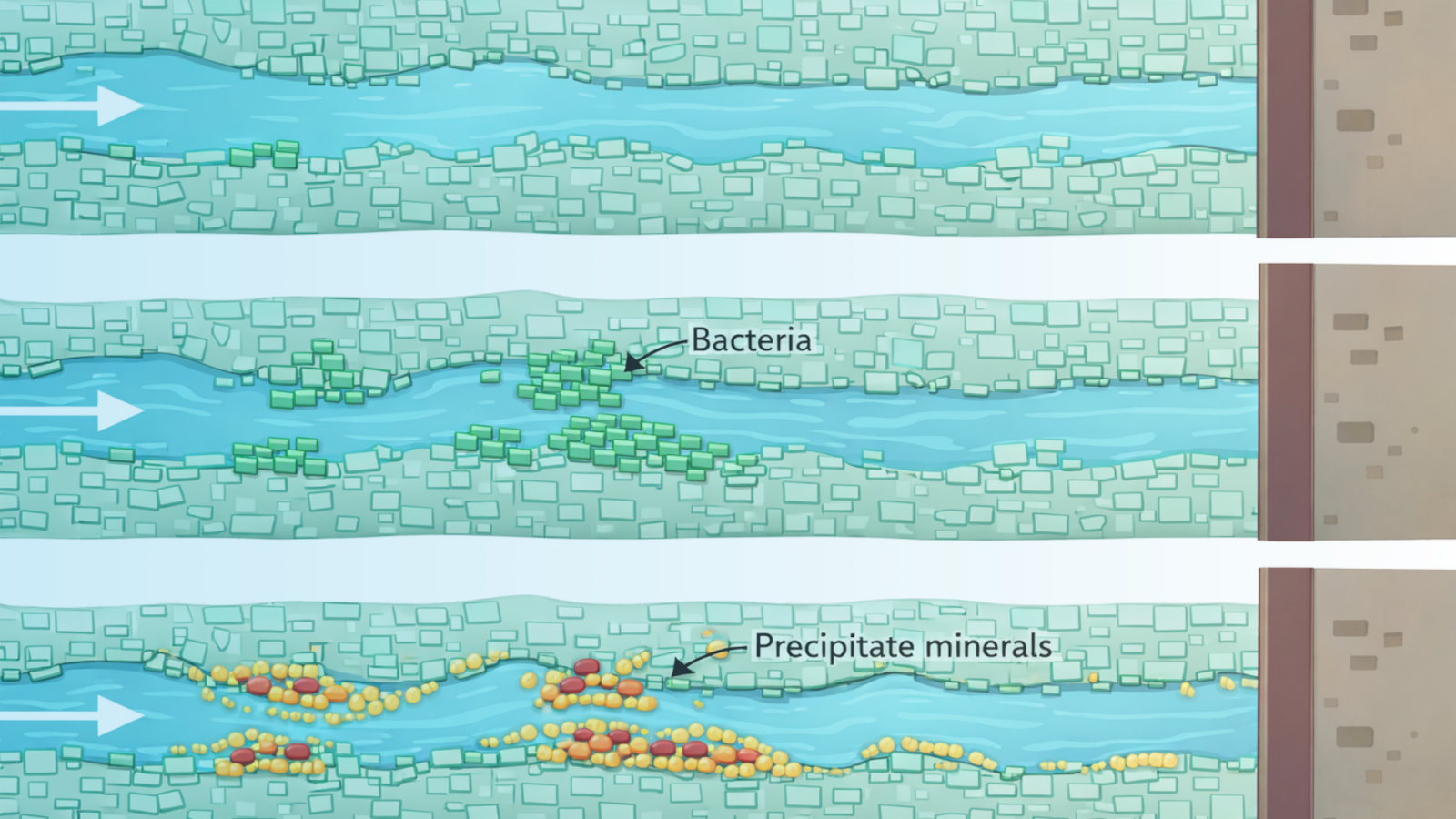
The healing mechanism that occurs in bacterial concrete relies on Microbial-Induced Calcite Precipitation (MICP). The microorganisms under normal conditions are dormant. But when microcracks are formed & water enters the concrete matrix, the healing starts.
The procedure involves the following steps:
Crack Formation: Microcracks are formed due to the influences of force and/or the environment.
Moisture Ingress: Water enters the crevices, awakening the dormant bacteria.
Bacterial Metabolism: Bacteria metabolize calcium lactate.
Calcium Carbonate Precipitation: Insoluble calcium carbonate is a by-product of this reaction.
Crack Sealing: The calcium carbonate precipitates to fill the cracks, restoring the impermeability.
Conditions such as the presence of moisture, the supply of oxygen, and temperature are very important for the activation and efficiency of bacterial action.
Benefits of Bacterial Concrete

Enhanced Durability:
Bacterial concrete reduces the permeability significantly, which locks the microcracks and thus prevents the entry of water with a consequent reduction in the corrosion of the reinforcement.
Cost-Effectiveness:
Even with the higher initial investment in bacterial concrete in comparison to conventional concrete, the costs associated with repair, maintenance, and rehabilitation of the structure make it an economically feasible option.
Sustainability:
Bacterial concrete works to promote sustainable construction through extending the lifespan of concrete structures and minimizing repair needs. It also mitigates material use, energy, and emissions produced by performing repairs.
Improved Structural Integrity:
It also prevents the propagation of microcracks. This is made possible by the autonomous sealing process that occurs on the microcracks.
Applications in Construction
Bacterial concrete is particularly suitable for structures where durability and low maintenance are critical. To help you understand better, here are some common applications:
- Infrastructure Projects: include highways, retaining walls, bridges, and tunnels that are subject to heavy traffic and severe weather.
- Water-Related Structures: include sewage systems, dams, reservoirs, and marine structures that are constantly exposed to moisture.
- Residential & Commercial Buildings: Basements, slabs, and foundations are vulnerable to temperature-induced cracking and shrinkage.
- Pavements and Industrial Floors: Areas that are subjected to repeated loading and abrasion.
Challenges and Limitations
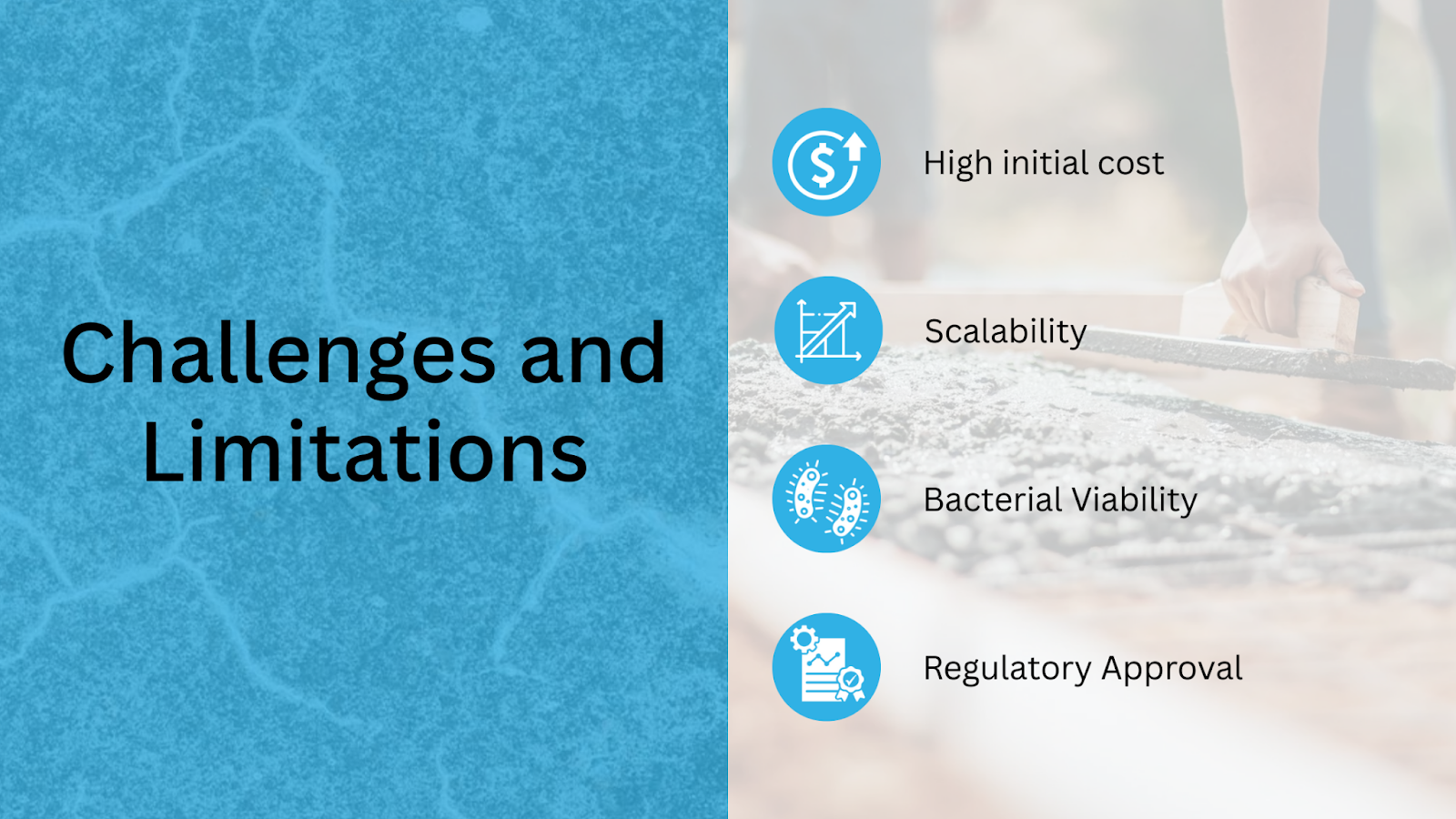
Cost
The addition of bacteria and nutrients in the form of capsules increases the cost of the raw materials for making concrete compared to regular concrete.
Scalability
Large-scale production of bacterial concrete involves issues relating to the uniform distribution of bacteria, quality, and standardized mix proportions.
Bacterial Viability
The problem of ensuring the bacteria are viable for decades within the concrete matrix is a pressing one. This requires efficient encapsulation of the bacteria in the concrete mixture process.
Regulatory Approval
Because codes and standards are not yet established for bacterial concrete, it has limited application. In many places, standards are still being developed.
Future Prospects

The research has continued with improvement and development in the strains of bacteria, nutrient delivery systems, and encapsulation techniques to make them more effective and long-lived. Bacterial concrete in the future would be more reliable and cost-effective with further developments in biotechnology and material sciences.
Embedding these materials with other smart materials and sensors, as well as BIM-based monitoring systems, is envisaged for future developments, which would result in fully intelligent structures. Broader adoption and technological fine-tuning could also further bring down the cost, thereby making bacterial concrete more viable for mainstream construction.
Conclusion
In this article, we helped you understand each aspect of bacterial concrete and why it is a major leap in the development of concrete materials. Bacteria concrete applies the principles of nature and concrete construction materials together for a sustainable solution to concrete’s long-standing problem of cracking.
Capabilities such as the ability to heal itself, minimize maintenance, and upgrade durability make it a potent weapon in the pursuit of sustainable building. Although the current issues surrounding its cost, scalability, and regulations are a challenge to its efficiency, it is a matter of time before the full potential is realized.
FAQs
1. What types of bacteria are used in bacterial concrete?
Primarily, Bacillus bacteria, such as Bacillus subtilis and Bacillus sphaericus.
2. How long can the bacteria remain dormant in concrete?
The bacteria can lie dormant for decades, only becoming active in the presence of moisture and cracks.
3. Can bacterial concrete be used in all climates?
It can be used, but it performs well in moisture; extreme temperatures & dryness can lead to poor activity of the bacteria
4. What are the environmental benefits of using bacterial concrete?
- It reduces repair frequency
- Lowers material consumption
- Decreases carbon emissions
5. How does bacterial concrete compare to traditional self-healing methods?
Bacterial concrete uses natural biological processes, offering long-term and environmentally friendly self-healing.