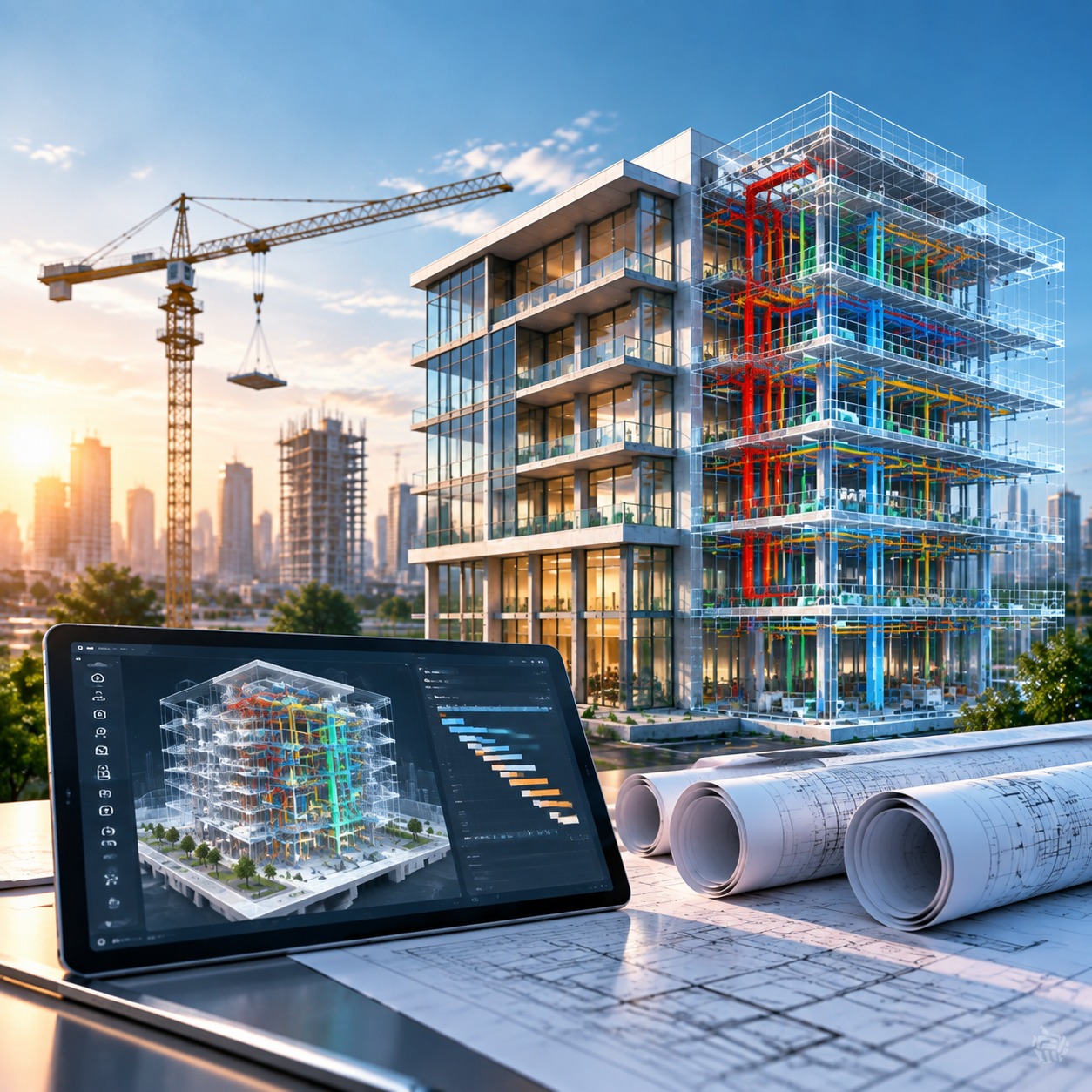

The construction industry is in the midst of one of the most significant technological transitions in history. The traditional processes based on static plans, spreadsheets, and unconnected data are being replaced in rapid order by smart 3D models and collaborative construction project platforms. BIM (Building Information Modeling) is at the forefront of this change, allowing users to plan, design, coordinate, and manage projects more accurately than ever before.
With the development of BIM, the function of the tool is also expanding from just visualization of design in the past into other functions that include project sequencing, cost estimation, facility management, and lifecycle optimization. One of the most significant developments in this area is that of 5D BIM, which is the integration of cost information into 3D BIM and construction schedules.
For organizations such as Techture, 5D BIM has become an essential offering, delivering value to developers, architects, engineers, and contractors by offering them real-time visibility regarding project finances, minimizing risks, and ensuring construction outcomes with confidence.
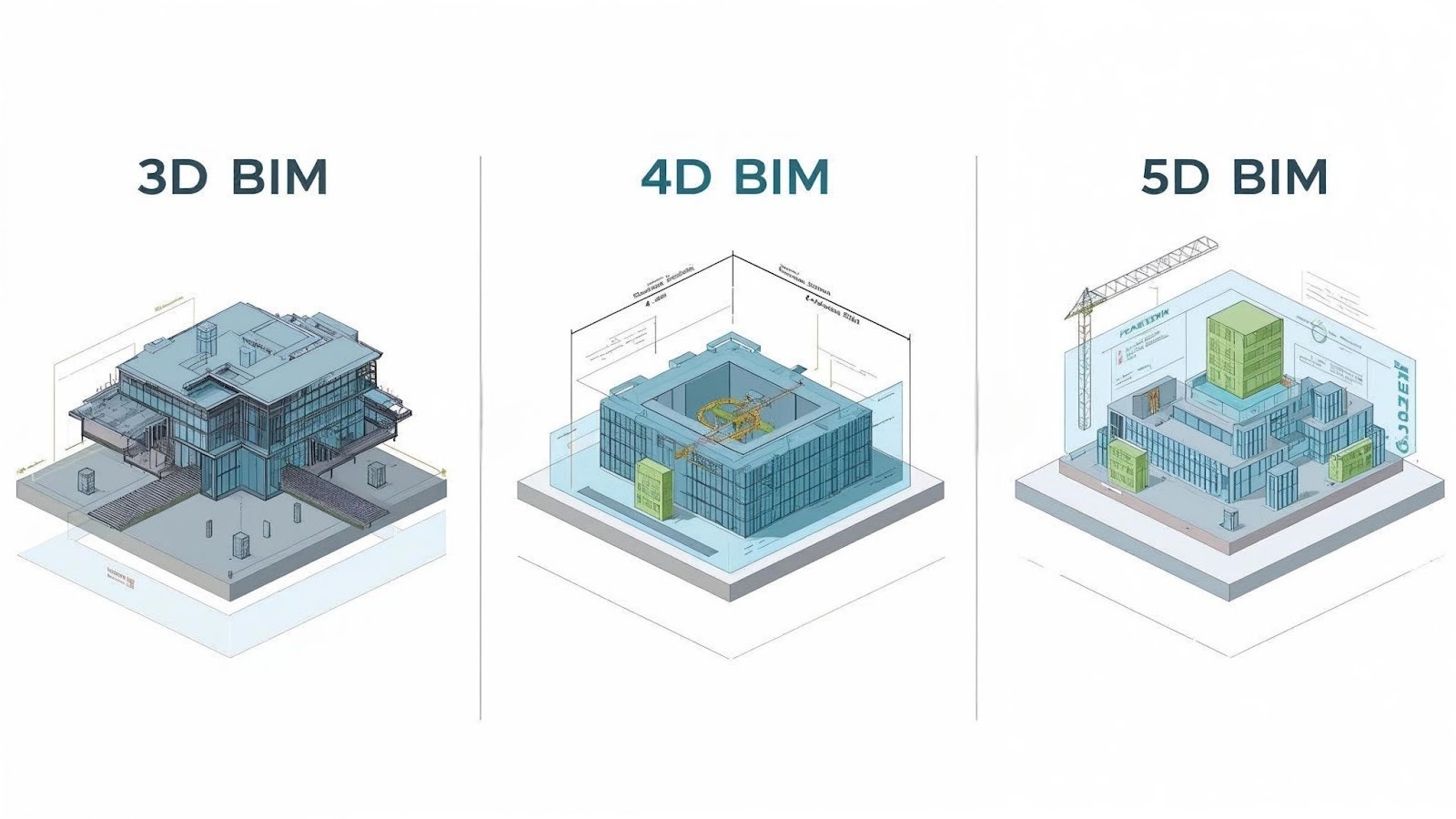
A Quick Look at BIM and Its Evolution
BIM evolved as a digital tool that could render hand drafting and unconnected CAD models redundant through the creation of intelligent 3D models. Initially, BIM applications were based on geometry, accuracy of design, and visualization in three dimensions—often called 3D BIM.
The following significant step was the integration of scheduling data (4D BIM), enabling planners and constructors to analyze construction sequencing simulations and identify planning errors at an early stage. With the evolution of BIM solutions and their increasing use, decision-makers started requiring more insight into cost issues that have always been one of the most complicated for construction delivery projects.
This led us to the advent of 5D BIM, where cost estimation, quantity take-offs, forecast analysis, and budget analysis are integrated in relation to the project models. Now, instead of trying to respond to costly errors in projects, the projects are able to forecast, avoid costly errors, and make value-driven decisions through the construction life cycle.
What Is 5D BIM?
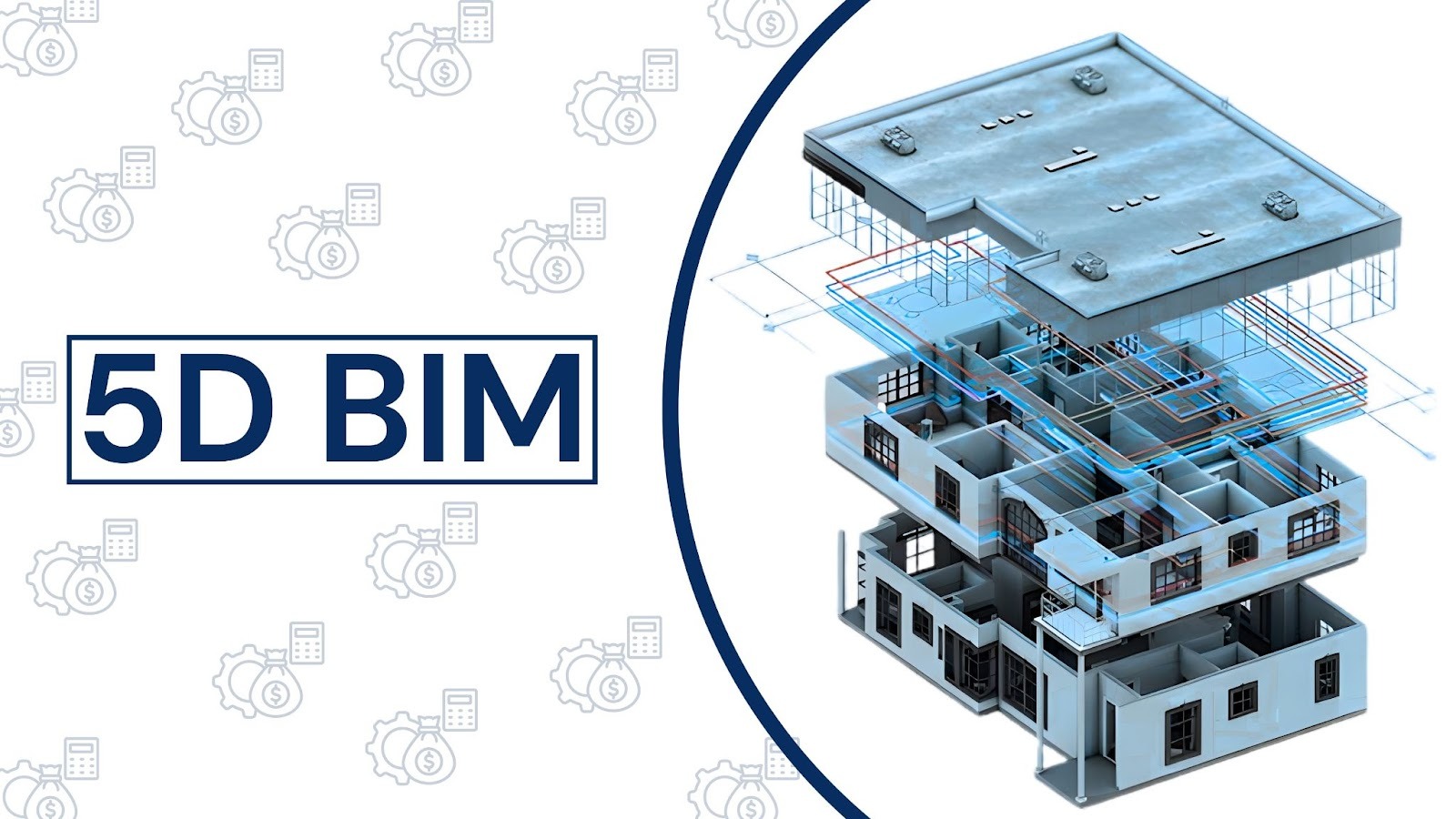
'5D BIM,' which stands for 'Fifth Dimension Building Information Modeling,' is the integration of cost data into the building’s 3D model, along with the construction timeline
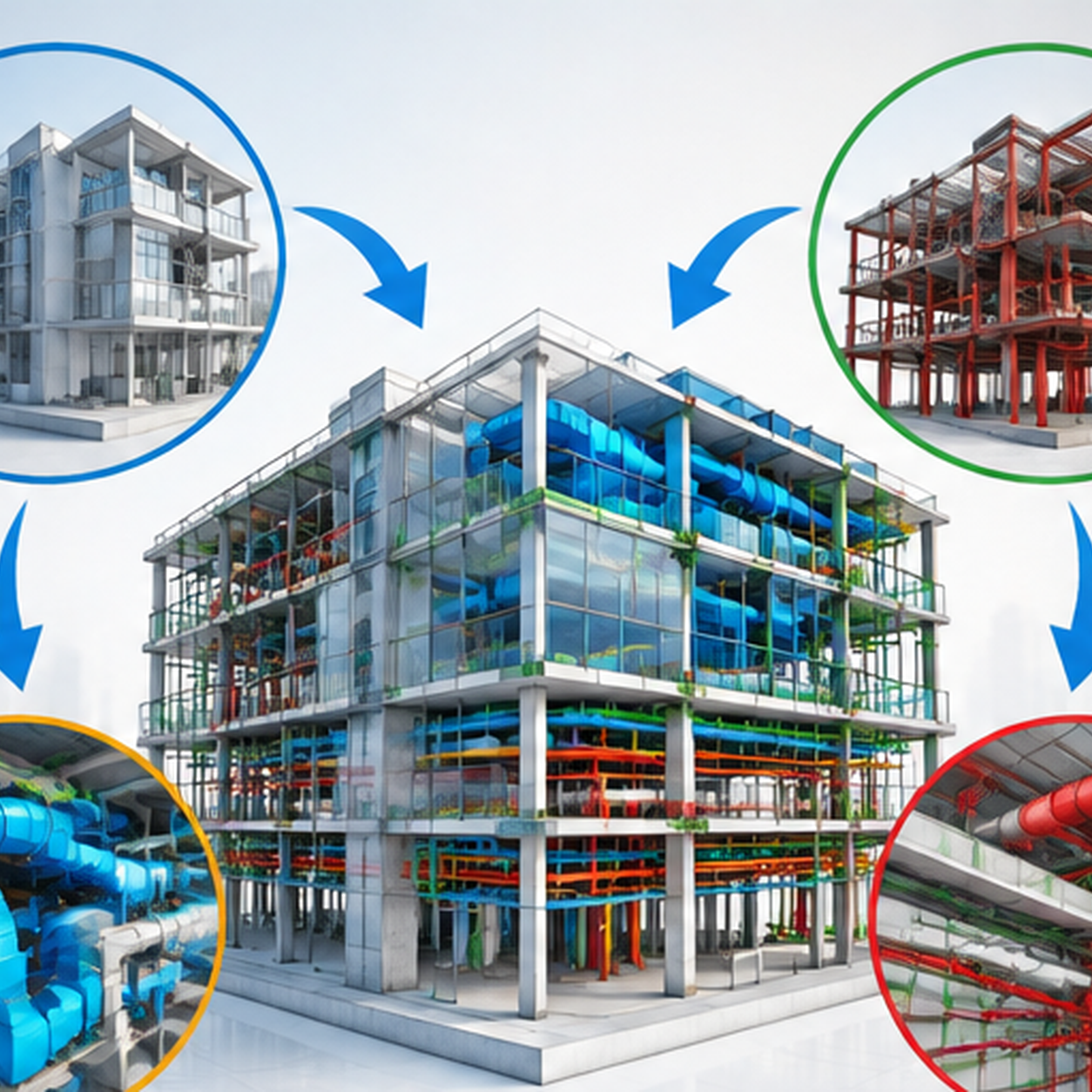
It provides a lively digital cloud-based system where all modeled elements, whether it is a wall, a slab, pipes, equipment, finishes, or services, are directly tied to cost items, material volumes, labor, and rate libraries. It automatically updates its cost estimate as and when there is a change in design or a change in scheduling.
5D BIM provides the following benefits for project delivery and management
- Real-time monitoring of project expenses
- Analyze design alternatives relative to cost-effectiveness
- Budget forecast changes through project phases
- Prevent unwanted overruns and rework activities
- Early decisions about design-to-budget
Rather than using spreadsheets and estimates, estimators, project managers, and owners work with one source of truth that links geometry, quantity, time, and cost.
- Core Elements of 5D BIM
1. Precise Cost Estimation and Control
The calculations are done on the basis of the modeled quantity and assembly, not assumptions. This has a significant positive effect on predictability.
2. Model-Linked Quantity Take-offs
Each design element will automatically calculate the required material and labor quantities. Whenever there is any change in the model, QTOs will be updated instantly without performing calculations manually.
3. Budget Forecasting & Tracking
They can also simulate various phases of projects, evaluate alternatives, and gauge cost effects before construction initiation.
4. Dynamic Updates During Design & Construction
Any change, no matter if it’s an edit for layout, value engineering choice, or a change in scope, will automatically provide insight into how costs and durations will change.
- Tools and Technology Behind 5D BIM
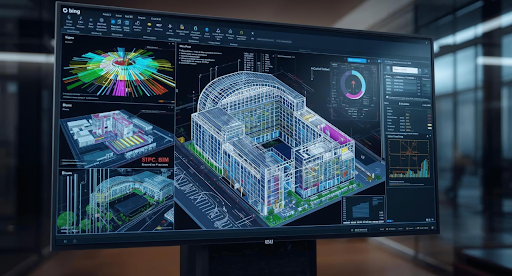
The software ecosystem for 5D BIM applications includes modelling, simulation, and estimation software. The main software platforms are:
- Autodesk Revit – Development of intelligent BIM models
- Navisworks Manage - Aggregation of models, extraction of quantities, and clash detection
- CostOS / Candy / WinEst / Sage Estimating – Cost estimation databases and bid management
- BIM 360 / ACC - Integrated Cloud Platform for Collaboration
Techture brings these environments together to create an efficient workflow where design, estimation, quantity take-off, and cost management are integrated seamlessly, either when communicating with owners, architects, GCs, or trade contractors.
How 5D BIM Is Transforming Construction Cost Management
The construction business is also dynamic, and in such a business, cost efficiencies can mean the difference between success and failure of projects. Such projects can easily get affected by design changes, prices for materials, and coordination problems.
With 5D BIM, there is visibility before decisions are finalized, avoiding surprises downstream.
Major consequences include:
- Real-time Cost Visualisation
The teams are aware of the financial implications of each design choice simultaneously.
- Improved communications between disciplines
The cost know-how is not retained by the estimator anymore, but designers, engineers, planners, and owners have access to synchronized information.
- Increased predictability and low-risk Dynamic
Models and cost mapping result in better accuracy of contingencies, and thus, there are fewer chances of cost overruns.
5D BIM transitions cost discussion from a reaction-based cost tracking process to a proactive cost leadership approach.
Key Benefits of 5D BIM
- Accurate Cost Estimation and Data-Driven
Removes guesswork required for estimation and offers highly accurate cost benchmarks.
- Quick, More Confidence Decision-Making
Teams can assess alternatives in an instant—substitutions for material or layout and sequence changes.
- Decreased Financial Risk
Functions performed early in the life cycle make possible improved purchasing decisions, fewer changes, and appropriate budgeting.
- Greater Transparency for Stakeholders
Owners, tenants, and financial partners clarify where expenses derive from to understand how funds are aligned with the scope.
Real-World Impact
Organizations employing 5D BIM will generally find positive results, including:
- Reduces manual quantity take-off time by 20-40%
- Reduced change orders as a result of earlier visibility
- Better accuracy in estimation at various design levels
- It is possible to reduce surprises about costs during procurement and construction.
The Techture has applied 5D BIM techniques in a range of projects, including commercial developments, residential projects, industrial projects, and infrastructure
- This intergration help clients by:
- Unite design changes with no budget impact
- Optimise material selection through value engineering
- Minimize Rework and Avoid Redundant Modeling Cycles
Challenges in Implementing 5D BIM

Although the benefit of “5D BIM” is well acknowledged, its implementation needs planning and maturity in the following areas:
- Data Integration Complexity
The structures of the models and project data have to match the cost databases for the automation to function correctly.
- Model Accuracy and Completeness
The accuracy of a cost model will depend on the quality of the design data to which it is tied; sloppy modeling means sloppy estimates.
- Interoperability in software
Not all platforms may collaborate effectively, requiring workflows, designs, and plugins.
- Requirements for Skills and Training
5D BIM requires hybrid skill sets that span engineering logic and quantity surveying expertise, along with modeling expertise.
Ideally, all these challenges can easily be managed in the right partnering and workflow environment.
The Future of 5D BIM in Construction
The coming decade will see the evolution of 5D BIM into an integrated project control system alongside other technologies such as:
Cost estimation based on AI support: Material mapping and estimation
Cloud Collaboration Tools and Digital Twins: Live Cost Monitoring Across the Entire Lifecycle
Integration of IoT and Procurement: Pricing and Visibility for Materials in Real-Time
Lifecycle costing: More than understanding the cost of construction, there’s a need for understanding the cost of operation over time.
Techture is also continuing to stretch the frontiers of construction digitalization by integrating automation, cloud solutions, and data intelligence capabilities with 5D construction and building modeling capabilities.
Techture’s Expertise in 5D BIM
Techture is experienced in BIM-VDC service delivery in relation to the design, engineering, and construction phases.
We assist in the following
- Model-based cost planning at various stages of design
- Automation of quantity take-offs from BIM models of geometry
- Cost-Loading Schedules & Procurement Forecasting
- Processes that reduce duplication and risk in the digital workflow
- Provides a collaborative ecosystem for owners, designers, and contractors with common goals
With many decades of experience in BIM implementation, Techture provides project-ready solutions in 5D BIM to assure cost certainty and construction efficiency.
Conclusion
The 5D BIM has developed from an idea into a useful and necessary element in cost leadership in the construction (AEC) industry. It provides the opportunity to integrate the cost and time information with the design in one intelligent system (model).
Therefore, it enables the industry to:
- Forecast the budget change early
- Prevent overruns
- Enhance procurement Decision-Making
- Minimize costly rework
- Improve transparency and stakeholder confidence
With the adoption of BIM gaining momentum, the 5D BIM approach to construction estimation and cost control is only set to become more mainstream. Techture is at the forefront of this revolution in construction, through its unparalleled knowledge in the BIM & VDC area.
FAQs
1. What exactly does 5D BIM include in a construction project?
5D BIM integrates the 3D model and 4D construction schedule with cost data such as material costs, labour costs, equipment costs, and procurement rates. This allows costs to be forecasted in real-time as work is executed.
2. How does 5D BIM help in cost estimation and budget tracking?
Cost elements correlate with model components, thus meaning that each change made within the designs automatically resets the cost estimates.
3. Which software tools are used for 5D BIM modeling?
Revit, Navisworks, CostOS, Synchro, Candy, WinEst, and Autodesk Construction Cloud can be considered as widely utilized platforms for 5D solutions.
4. What are the biggest challenges in implementing 5D BIM?
Cost integration in models, completing the model, standardizing cost libraries, and creating a skilled team are the most frequently occurring ones.
5. How can Techture assist in adopting 5D BIM for better cost control?
Techture delivers end-to-end BIM solutions, right from modeling and QTO extraction, through cost simulation and procurement integration, in an effort to ensure client control over project budgets and mitigate project risks in a manner that improves decision-making.