.png)

What if we tell you the architecture, engineering, and construction (AEC) sector is about to enter a new era? Yes, you heard it right, in the near future, in the AEC industry, you will encounter that automation is boosting creativity and computation is strengthening intuition.
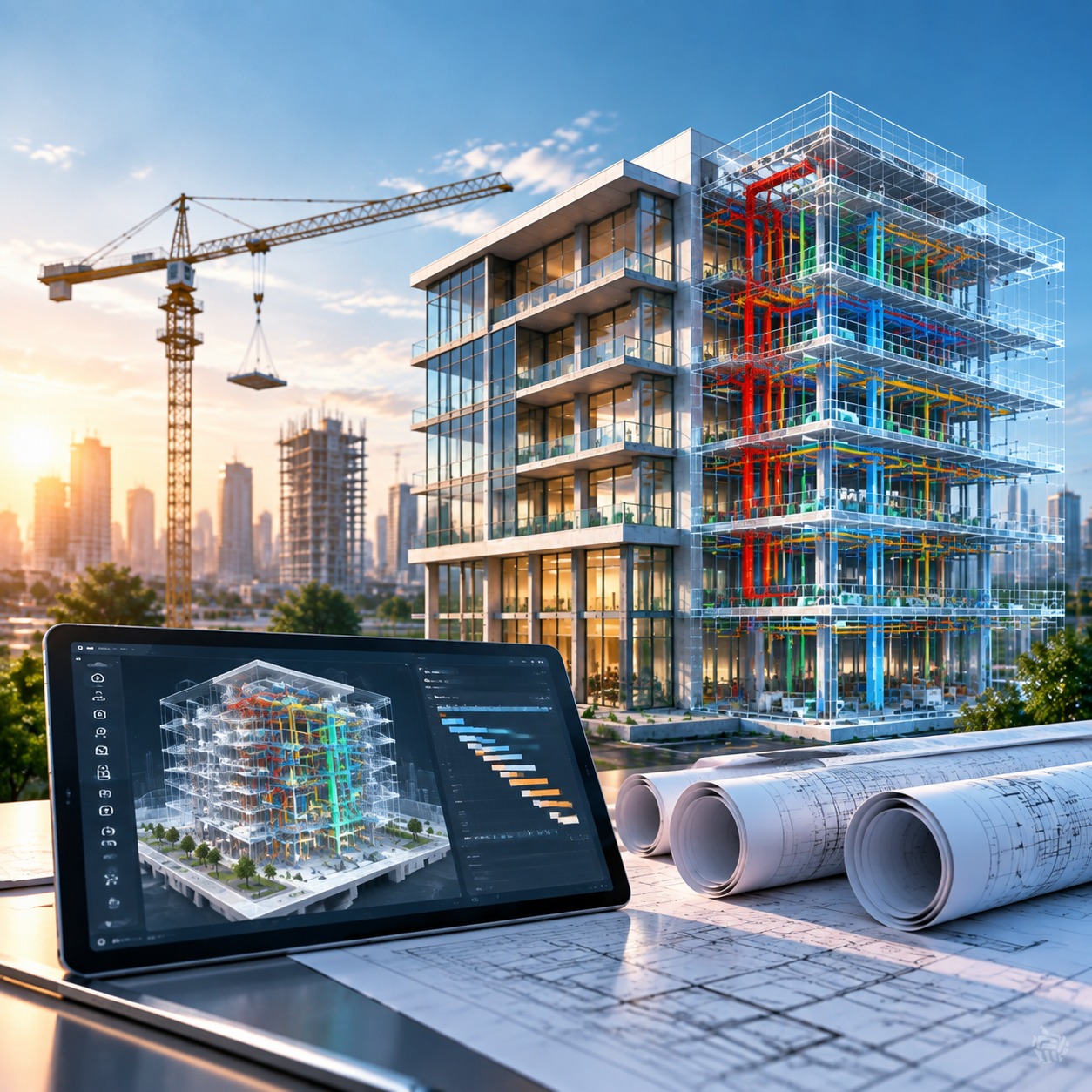
BIM Generative Design, a powerful fusion of Building Information Modeling (BIM) and algorithm-driven design exploration, is at the center of this change. By automating the creation and evaluation of design alternatives, generative design is transforming how architects, engineers, and contractors approach planning, problem-solving, and project delivery.
From optimising floor plans to designing energy-efficient façades and evaluating structural layouts, BIM generative design catalyzes better, faster, and more sustainable decisions. In this article, we will explore some fundamentals of generative design within BIM, its workflow, how it benefits us, the tools used, applications, and promising future trends shaping digital architecture and construction.
What is BIM Generative Design?
The BIM Generative Design is an advanced design methodology that merges the data-rich environment of BIM with algorithmic, goal-driven generative design workflows. Giving us a better alternative for drafting options, designers input goals, performance criteria, and parameters. The system then generates, evaluates, and ranks multiple design options using advanced computational algorithms, helping teams quickly compare and select the most suitable solution.
In order to understand the BIM generative design in simple words, here is the point-wise essence:
- Helps automate the exploration of multiple design possibilities
- Evaluates how each option performs within project constraints
- Optimizes outcomes based on clear, measurable objectives
- Take & use BIM data to make sure results are accurate and practical for building
By integrating building information modeling (BIM) with generative design, users can generate solutions that bridge the gap between conceptual design and practical construction.
How Does Generative Design Work in BIM?
Generative design within the BIM operates with a systematic, step-wise workflow designed to optimize project outcomes:
- Defining clear Goals & Constraints: The designer set goals and constraints for maximizing daylight or minimizing material use
- Setting Parametric Inputs: Then, the parametric inputs, like room sizes or façade angles to establish the model's mathematical variables.
- Run Algorithms: it runs genetic or evolutionary solvers to generate countless design options based on these rules. Each generated option is verified and ranked using performance metrics directly extracted from the BIM model.
- Selects & refines the optimal solution: The designers combine the data-driven result back into the BIM environment for detailed documentation and coordination.
Benefits of BIM Generative Design in Architecture and Construction
The combination of generative design & BIM converts project workflows from traditional linear processes into dynamic, data-driven cycles of exploration and optimization, helping us with 5 Key benefits:
- Improved design efficiency and innovative solutions:
Generative design covers ideas that help shape smarter floor plans, stronger and more responsive façades, efficient use of materials, and distinctive forms grounded in real project data. In simple words, it boosts creativity while backing every decision with solid performance results.
- Cost Reduction and Resource Optimization:
With a proper data-driven generative design, we can analyze material quantities, energy usage, structural loads, and spatial layouts. This results in helping us reduce material waste, costly rework, project budget, and overall operational expenses.
- Faster iterations:
Manual drafts that took weeks to develop can now be made in minutes with automation. With the generative design, we can produce hundreds of options with ease, helping us make faster decisions and save time & effort.
- Enhanced Coordination
When generative design is carried out within a BIM environment, it produces coordinated, clash-free, and information-rich layouts that flow seamlessly into downstream workflows such as MEP, structural design, costing, and scheduling.
- Improved Sustainability
It enables teams to assess all energy consumption elements, providing an advantage in tracking their carbon footprint. By selecting optimal solutions early, buildings can become more sustainable.
Key Tools and Software for BIM Generative Design

- Autodesk Revit: Revit streamlines the creation of multiple designs based on defined performance objectives. This interfaces directly with BIM elements, including Revit families, parametric models, and external Dynamo scripts. Its primary use cases center on optimizing spatial arrangements, such as space planning, intricate façade studies, defining interior layouts, and preliminary structural optimization.
- Dynamo (Visual Programming for Revit): Dynamo provides a versatile, node-based scripting environment that empowers users to create highly customized generative design logic. Its direct connectivity to Revit facilitates tailored workflows for geometry automation, advanced parametric modelling, performance-driven design analysis, sophisticated data extraction, and the execution of optimization routines.
- Rhino + Grasshopper: This pairing represents a powerful parametric modeling ecosystem. Rhino 3D provides the advanced geometric kernel, while Grasshopper furnishes a visual scripting interface that enables advanced geometric control, complex façade design, the development of custom structural algorithms, and integrated environmental analysis.
- Autodesk Fusion 360: This is designed for generative design applications within product design and fabrication. It stands out in structural optimization, generating manufacturing-ready geometry by defining loads and constraints, and conducting detailed material efficiency studies.
- Bentley Systems (e.g., OpenRoads, MicroStation): They provide frameworks helpful for infrastructure and large-scale generative modeling within a comprehensive BIM ecosystem, facilitating complex civil and transportation project design through algorithmic processes.
Real-World Applications of BIM Generative Design
- Space Planning and Layout Optimization
The generative design is important for rapidly optimizing spatial relationships within buildings. By establishing parameters like circulation flow efficiency, required daylight access, and adjacency requirements (e.g., proximity of a lab to a testing area), designers can instantly evaluate hundreds of layouts for:
- Residential Units
- Commercial Offices
- Complex Facilities (Hospitals, Schools)
- Façade and Envelope Design
The building envelope is critical to energy performance, and generative tools allow for performance-based design of its components. This optimization is crucial for:
- Shading
- Panelization
- Kinetic Facades
- Structural Optimization
With generative techniques, engineers find the most efficient structures that satisfy load requirements while reducing material use, directly impacting construction cost and sustainability.
- Applications include:
- Material Reduction
- Grid Optimization
- Topology Optimization
- MEP Routing and Coordination
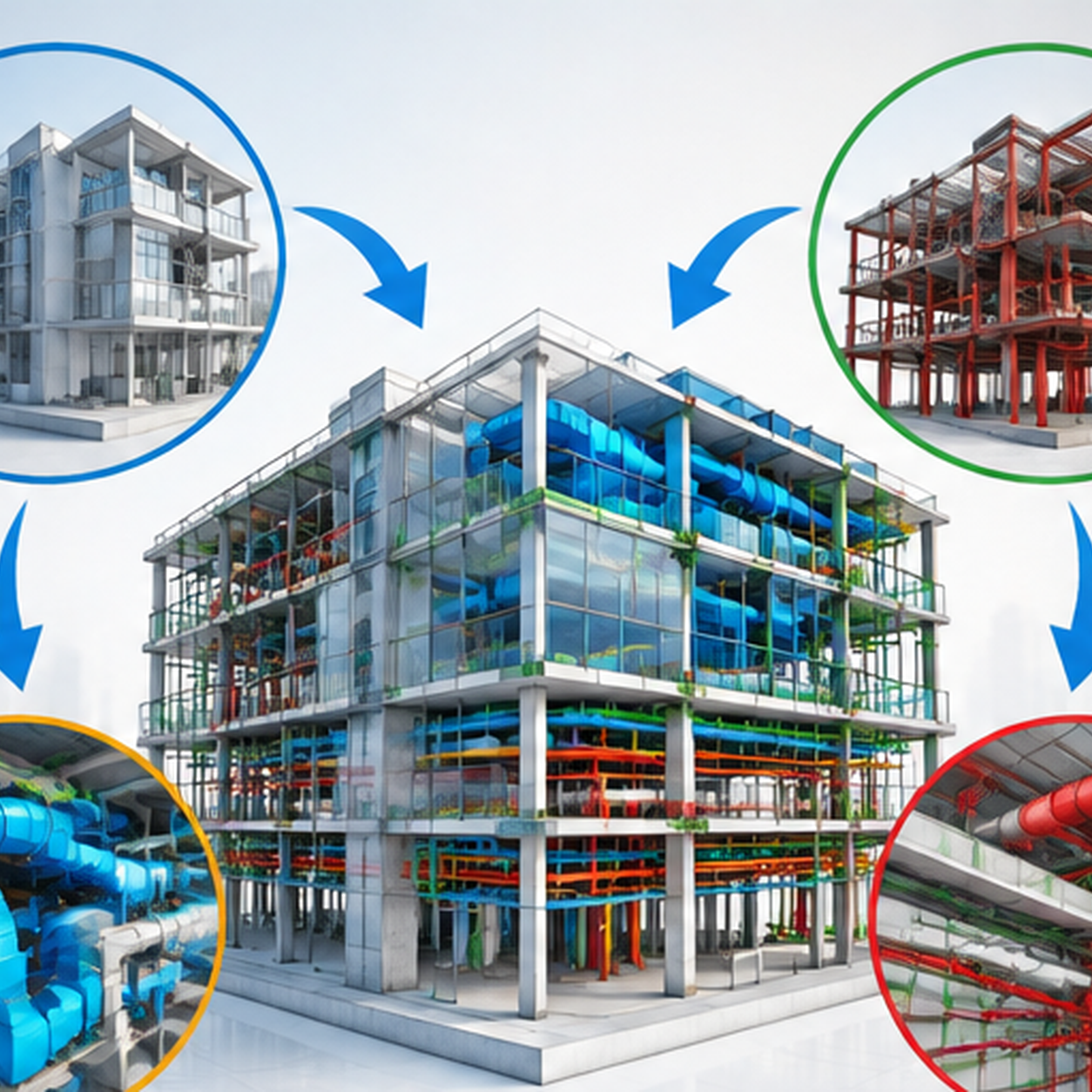
The algorithms can automatically route different elements and provide clash-free pathways, system performance, and minimal material usage, which significantly reduces coordination time and onsite rework.
Different elements that can Route and Coordinate:
- Ductwork
- Pipe networks
- Cable trays
Challenges in Implementing BIM Generative Design
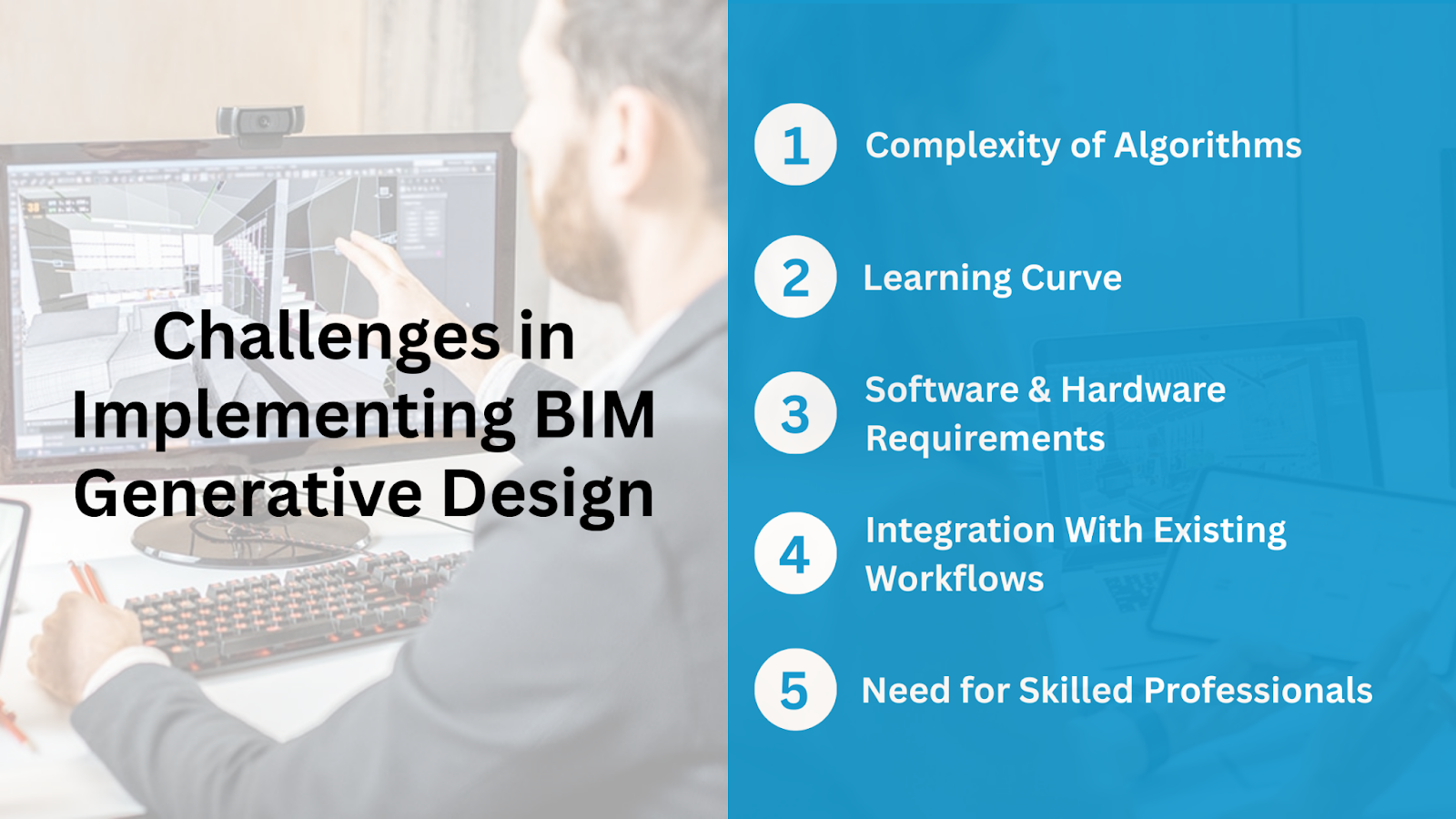
- Complexity of Algorithms
The difficulty in generative design lies in mastering the required algorithmic elements, such as Optimization Logic, Parametric Rules, Performance Metrics, and the Computational Workflows. - Learning Curve
Using tools like Dynamo and Grasshopper can be challenging because they require a strong skillset in terms of problem-solving & visual scripting - High Software and Hardware Requirements
We require strong processing power and robust software ecosystems because the simulations of Generative designs are intensive & complex. - Integration With Existing Workflows
Teams need to integrate the generative design with the existing LOD requirement, coordination workflows, and overall timeline, all aligned with BIM standards. - Need for Skilled Professionals
As it is quite complex to understand, the professional should have at least a basic understanding of BIM, parametric modeling, data science, and architecture/engineering fundamentals to provide relevant outputs.
Future Trends in BIM Generative Design
The future of BIM generative design looks promising with an ongoing trend of advanced technologies. The trend emphasizes the creation of systems that can learn from historical project data, predict outcomes, and generate solutions that simultaneously satisfy complex, multi-objective goals for cost, sustainability, and structural integrity.
Future trends include:
- AI-Powered Design Intelligence
- Integration With Digital Twins
- Fully Automated Construction Documentation
- Enhanced Real-Time Visualization
- Cloud-Scale Computation
Best Practices for Implementing BIM Generative Design
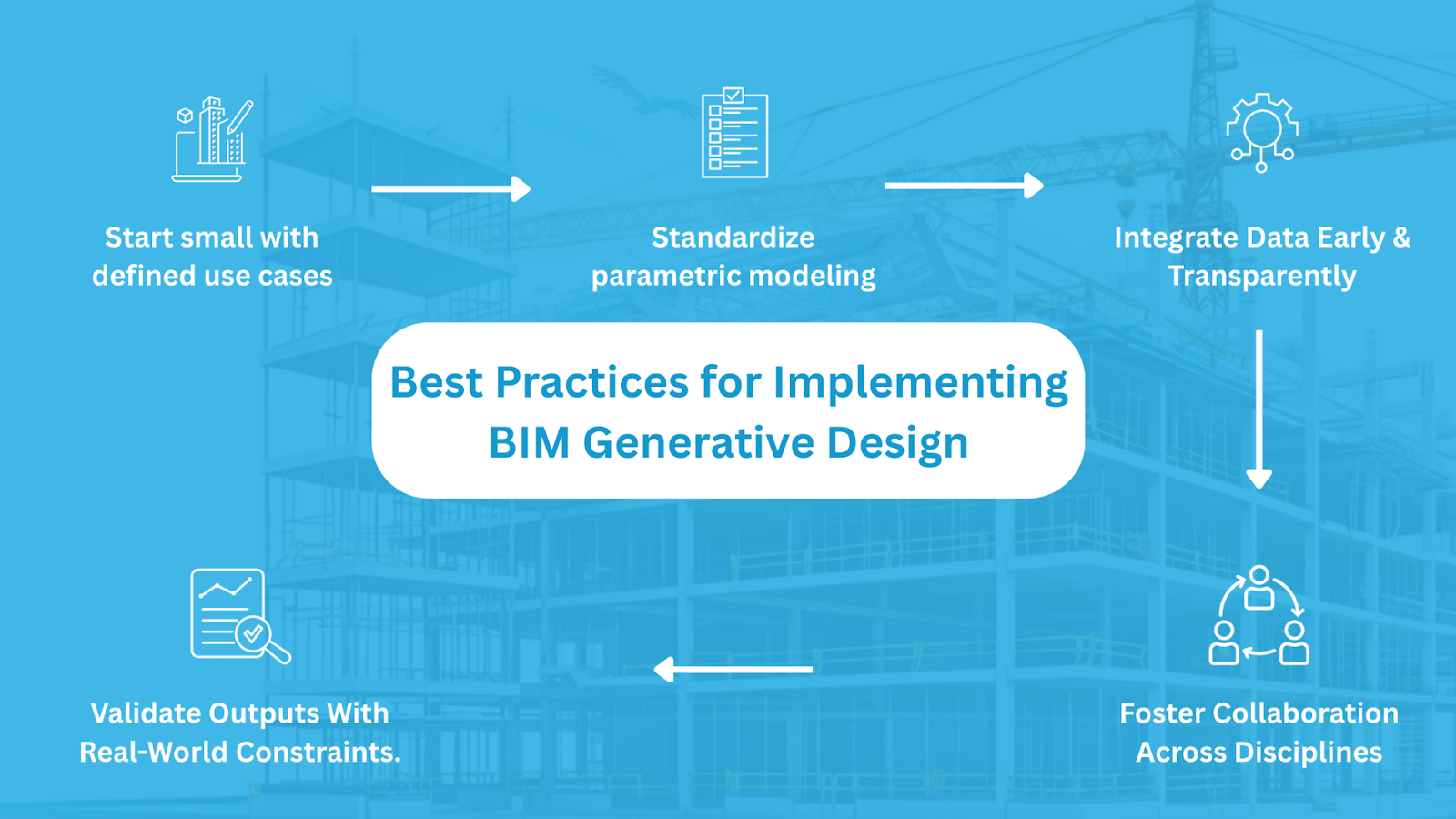
Start small with defined use cases
It is recommended that you kickstart with simple workflows, such as façade optimization, unit layout studies, and column grid optimization.
Standardize parametric modeling
Using consistent naming conventions, reusable scripts, and well-structured parametric families helps us in smoother execution and reduces rework.
Integrate Data Early & Transparently
The early integration of data provides you with clear, reliable generative performance and maintains accurate BIM models, clean geometry, defined constraints, and shared parameters.
Foster Collaboration Across Disciplines
It is important that architects, engineers, and contractors collaborate on performance goals, design rules, and evaluation metrics to make sure the generative results align with project realities.
Validate Outputs With Real-World Constraints.
Always review generated solutions with respect to building codes, safety, cost implications, and constructability to ensure they are practical and buildable.
FAQs
1. How can generative design improve sustainability in construction?
Generative design helps teams study factors like energy use, daylight, material choices, and carbon impact. This makes it easier to choose solutions that lower the environmental footprint while still meeting the project’s functional needs.
2. Can generative design be used for both new construction and renovations?
Absolutely, generative design can be used for both new construction and renovations.
3. What software is commonly used for BIM generative design?
- Rhino with Grasshopper
- Autodesk Revit
- Dynamo
- Fusion 360
- Bentley
4. How does BIM generative design reduce project costs?
By refining layouts, improving material efficiency, and resolving performance issues early.
5. How do architects and engineers collaborate using BIM generative design?
From shared parametric models and agree on clear performance targets and evaluation criteria.